Facebook
 X
X
 Pinterest
 Copy Link
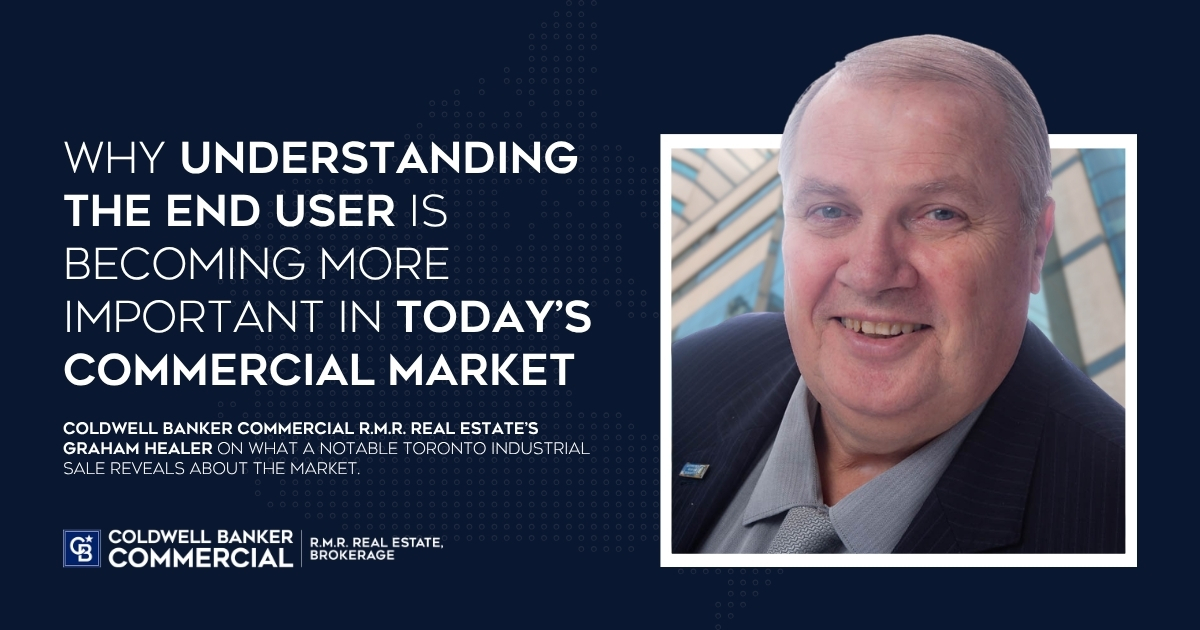
Coldwell Banker Commercial R.M.R. Real Estate’s Graham Healer on what a notable Toronto industrial sale reveals about buyer behaviour, market positioning, and the value of knowing who an asset is really built for.
The commercial real estate market is still moving, but the path to a successful sale has become more deliberate.
Over the past two years, investor activity has pulled back from peak levels, underwriting has tightened, and assumptions around rent growth and financing have become more conservative. Leasing conditions have also softened in certain pockets, creating a market where buyers are still present, but far more selective about where and how they move.
For brokers and sellers, that shift has made positioning more important than ever.
A successful listing strategy now requires a clear understanding of who the property is best suited for, how that buyer is evaluating opportunities, and whether the asset is structured in a way that allows them to act.
For Graham Healer, Broker and Managing Director with Coldwell Banker Commercial R.M.R. Real Estate, that distinction has become increasingly important.
“There’s still demand,” he explains. “But it’s not coming from the same places it used to. You have to be more intentional about who you’re trying to reach.”
Investor Demand Has Become More Selective
Investor buyers remain an important part of the commercial market, but their approach has become more measured.
Where pricing was once supported by strong rent growth, easier financing conditions, and more competitive bidding environments, today’s investors are placing greater emphasis on stability, downside protection, and realistic assumptions around future performance. Lease terms, tenant quality, renewal risk, capital requirements, and exit conditions are all being assessed more carefully than they may have been in the previous cycle.
That has made some properties more difficult to position for an investor audience, particularly when there is uncertainty around income or future leasing conditions.
Healer saw this directly in a recent industrial listing in Toronto’s Rexdale corridor.
The challenge was that investor buyers were evaluating the asset through an income-based lens, and their view of value reflected that. In many ways, the offers coming forward were logical within the framework that those buyers were using.
“The investor numbers weren’t wrong,” he says. “They were just based on a different way of looking at the building.”
Why End Users Are Seeing Value Differently
At the same time, end users have become an increasingly important part of the buyer landscape for many types of commercial properties.
These buyers are evaluating a property through the needs of their business. Location, access, visibility, parking, configuration, zoning, operational efficiency, and the ability to control their space over the long term can all influence how they perceive value.
For the Rexdale property, Healer recognized that the strongest opportunity was likely to come from a buyer whose business could directly benefit from the building itself.
The location offered strong visibility, and the space was functional. The property had qualities that were meaningful to an owner-user, even if those qualities were being interpreted differently by the investor market.
“The value was always there,” he explains. “It just wasn’t going to come from the investor market.”
That approach was central to the recent sale of 75 City View Drive in Toronto’s Rexdale industrial corridor, a notable commercial transaction that closed on March 25, 2026, for $6 million. For Healer, the sale reflects how, in today’s market, a well-considered strategy can materially shape how an asset is understood.
Positioning the Asset for the Buyer
A shift in perspective led to a closer examination of how the property was structured and whether it supported the buyer most likely to move forward.
At the time, the building was fully leased. From an income standpoint, that can be attractive. For an end user, however, occupancy matters. If a buyer cannot understand when and how they could use the space, the opportunity becomes harder to evaluate.
Healer worked with the seller to consider the lease structure, tenant usage, renewal timing, and the practical realities of how a future owner might occupy the building. That process helped reposition the property in a way that made it more accessible to an owner-user.
“An end user needs to be able to see themselves in the space,” he says. “If they can’t use it, it’s very hard for them to justify the purchase.”
By creating a clearer path to occupancy, the property became easier for the right buyer to understand and act on.
Use, Specs, and Operational Fit
One of the more nuanced parts of commercial real estate is that the same physical characteristics can be interpreted very differently depending on the buyer.
In industrial real estate, features like clear height, loading, building age, and configuration are often discussed as if they carry the same weight for every user. In practice, their importance depends heavily on the type of business being operated.
A distribution-heavy user may prioritize clear height and vertical storage. A service-based business, automotive user, light manufacturer, or contractor-supply operation may place greater value on frontage, access, visibility, or a layout that supports customer interaction and day-to-day workflow.
For the buyer who ultimately moved forward on the Rexdale property, the building aligned with the operational needs of the business. The features that mattered most were the ones that supported how the property would actually be used.
“That’s where deals come together,” Healer notes. “When the property actually fits what someone is trying to do.”
Strategy Before Exposure
Exposure remains important, but it is most effective when the strategy behind the listing is clear.
For Healer, that meant taking a targeted approach to outreach. In addition to listing the property through the appropriate commercial channels, he looked at recent sales activity in the area and identified the agents who had been involved in comparable transactions. From there, he sent the property package directly to those brokers, regardless of brokerage affiliation, with a clear understanding that the right buyer could already be connected to someone active in that specific market.
He also used platforms to create a more complete information environment for interested parties. Rather than relying on a listing, the goal was to make it easy for qualified buyers and their representatives to access the details they needed, understand the opportunity, and determine whether the property fit their requirements.
That kind of outreach reflects a practical reality in commercial real estate. A property can be visible and still miss the right buyer if the marketing is too general. Activity alone does not always indicate alignment. A listing may generate inquiries, showings, and even offers, while still failing to connect with the buyer who sees the strongest reason to move forward.
For brokers, this reinforces the importance of defining the strategy before amplifying it. That includes understanding how the property is likely to be interpreted by different buyer groups, identifying the most relevant audience, and making sure the marketing effort is directed toward the people most likely to influence or complete the transaction.
The Role of Patience in a More Deliberate Market
In a selective market, time on market can be easy to misunderstand.
A longer listing period may signal a need for change, and it can also reflect the reality of finding the right buyer in a more cautious environment. What matters is how actively the strategy is being evaluated and refined throughout that period.
For Healer, the process involved continuing to read market feedback, testing assumptions, adjusting the positioning, and remaining focused on the buyer profile that made the most sense for the asset.
Patience can be difficult for sellers, particularly when market conditions are uncertain. It becomes more constructive when the broker can clearly explain what is happening, why certain responses are emerging, and what steps are being taken to improve alignment between the property and the buyer pool.
A More Thoughtful Path for Commercial Sellers
For commercial sellers, the lesson is to think carefully about the audience a property is being positioned for, and to understand how that audience is making decisions in the current market.
In a more selective environment, successful outcomes are often shaped by how clearly the property is understood, how accurately the buyer pool is assessed, and how well the structure of the asset supports the buyer most likely to move forward. That requires patience, market fluency, and an advisor who can interpret feedback before decisions become reactive.
For some properties, the strongest path will still be an investor. For others, it may be an end user with a specific operational need, a longer-term view, or a stronger reason to value the property beyond income alone. The work is in identifying that path early enough to shape the strategy around it.
The 75 City View Drive sale offers a useful example of that discipline in practice. It reflects the value of looking closely at the asset, understanding where demand is actually coming from, and creating the conditions for the right buyer to act. In a market where decisions are more deliberate, strategic clarity can greatly influence the outcome.
This is where experience and access to broader market insight become increasingly valuable. Across the Coldwell Banker Canada network, that perspective is helping brokers approach listings with a clearer understanding of how demand is evolving, and how to position assets accordingly.